

A bridge between worlds ↓
2022 → 2024 → 2025 → 2026
ABM strategy (Account-Based Marketing) is not mass promotion → It is strategic precision. Instead of chasing everyone → you identify the accounts, ecosystems, investors, operators, or partners that can change the trajectory of a business or territory.
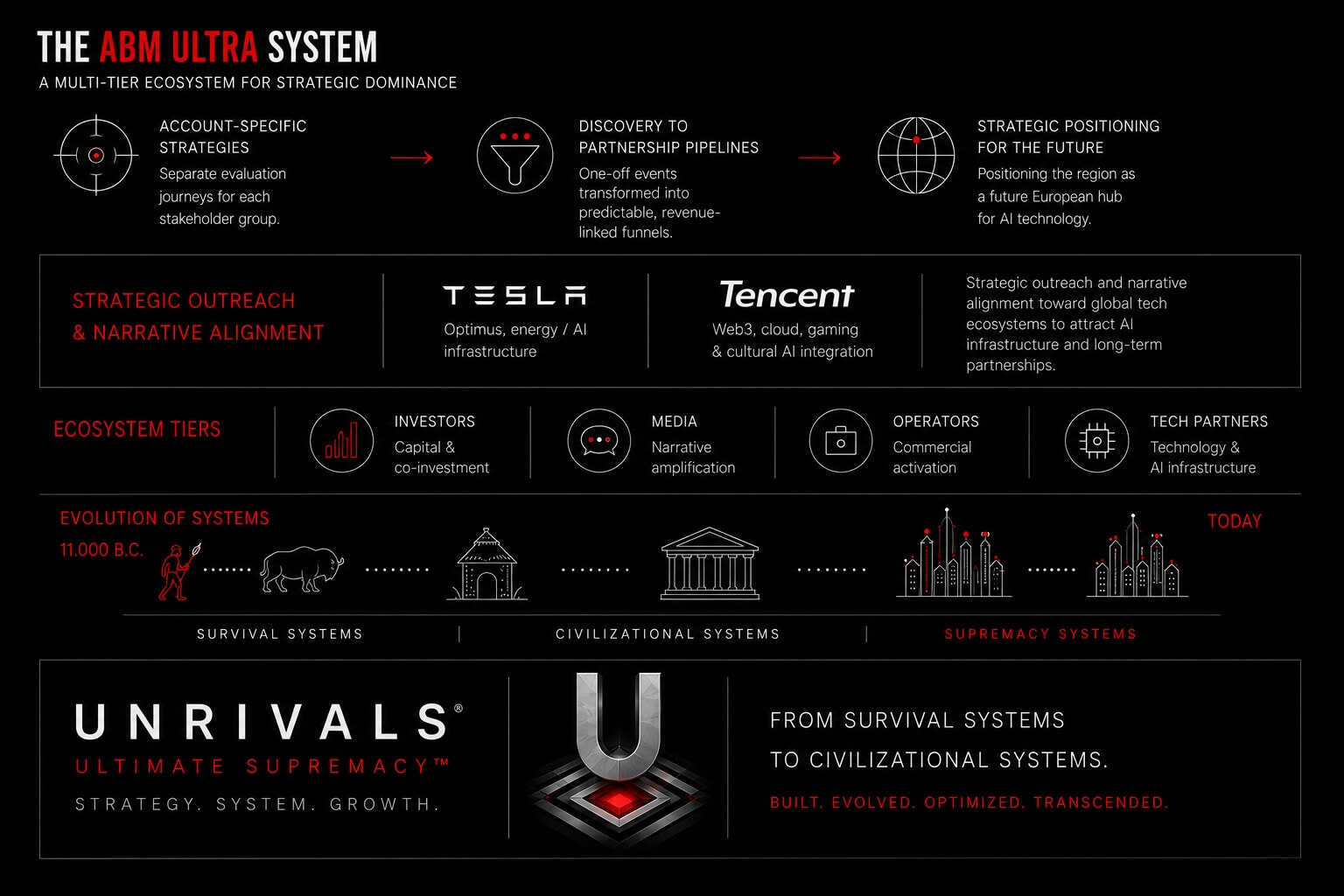
Territorial market positioning architecture → We don’t promote destinations. We build strategic territories → Traditional marketing optimizes visibility → ABM optimizes strategic relevance. The objective is not traffic. The objective is positioning inside the decision architecture of high-value stakeholders. Every audience tier receives a different narrative, different proof system, different value logic, and different activation path. In destination branding, ABM transforms a place from a tourism message into a strategic ecosystem. Investors see infrastructure. Media sees narrative. Operators see commercial opportunity. Tech partners see scalability.
ABM is essentially the transition from campaigns → to orchestrated strategic ecosystems. Not promotion. Alignment. Not impressions. Long-term partnership pipelines. Not generic communication. Cognitive positioning engineered for specific high-impact entities.
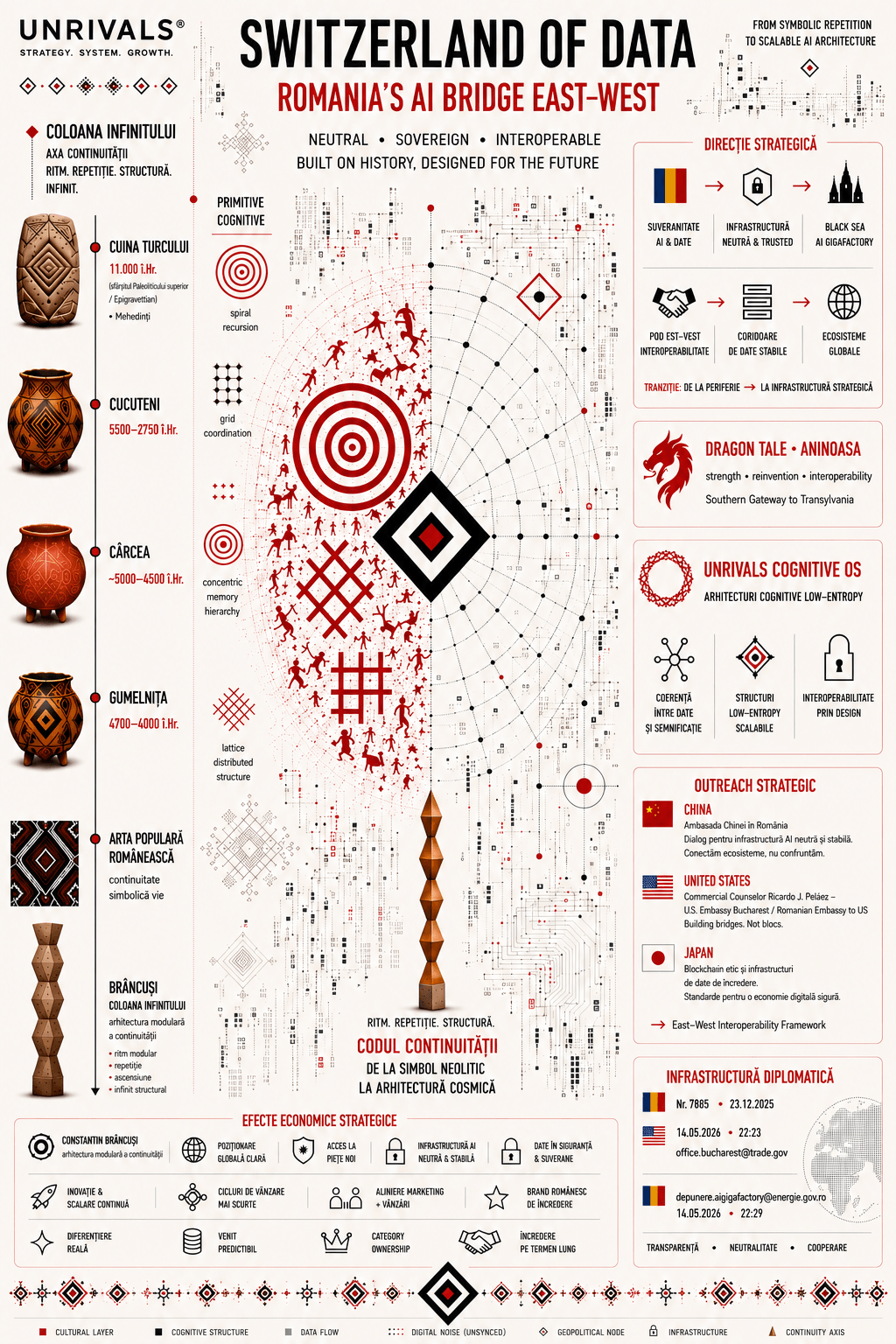
ABM Strategy AI Data Centers → JIU Valley From a neighborhood connected to Straja to 100 hectares in Aninoasa — this is a long-form ABM strategy positioning the Jiu Valley as a future AI data center corridor. Energy history, cooling infrastructure and strategic patience built before the market understood what was happening.
You are about to read something that does not behave like a marketing article → It does not announce a product. It does not pitch a destination. It does not ask for your attention the way most content does. What it does instead is far more unusual — it shows you the architecture of a strategy that was already four years in motion before most people understood what was being built.
The Jiu Valley → A territory most investors had mentally archived under decline. A region that had learned to describe itself in the language of loss — industry gone, mines closed, population leaving. That language, repeated long enough, becomes identity. And identity, once fixed, becomes gravity. The wrong kind. This is the account of how that gravity was reversed. Not through promotion. Not through a campaign. Through something that moves slower and lands deeper — account-based territory positioning, applied not to a company, but to an entire geographic corridor.
The longest ABM strategy we have ever run → And it is not finished. What started with a single urban development challenge — a neighborhood in Lupeni, disconnected from one of Romania’s most dynamic winter resorts — became the first visible proof of concept. Twenty thousand square meters. Land parcels. Four-star hotel capacity. A connection to Straja that did not exist before and now shapes the economic imagination of the entire surrounding area. That phase closed. The results are real. But this article is not a retrospective. It is a handoff. Because the next phase has already begun. One hundred hectares. Aninoasa. A territory being positioned from scratch — not as a tourism project, not as a real estate development, but as a future node in the infrastructure of the AI era. The audience for that phase is not a tourist. It is not a local investor. It is the kind of institutional and technological capital that thinks in decades, not quarters. Read carefully. The strategy will become clear. Four years, two territories, one strategic map.
Why would anyone spend years positioning a territory before asking for anything in return? Because the most valuable ecosystems in the world are never built through campaigns alone. They are built through meaning, continuity, infrastructure, and strategic patience. By the time the world notices them, the foundation has already been laid years earlier. That is the difference between promotion and strategic positioning.
Promotion tries to attract attention. Strategic positioning tries to change gravity. For a long time, regions like the Jiu Valley were trapped inside an old narrative. Industry collapse. Mining decline. Economic survival. Every conversation repeated the same identity until the territory itself started believing it.
But every territory has a hidden layer.
→ Some have beaches.
→ Some have ports.
→ Some have oil.
Others have symbolic power, geography, authenticity, energy history, mountains, cooling infrastructure and the rare ability to become a bridge between worlds that normally do not speak the same language → That is where the strategy started. Not with advertising. Not with tourism. Not with “visit Romania.” With one simple question: what if the Jiu Valley stopped positioning itself as a forgotten industrial region and started positioning itself as a future strategic corridor? The first phase looked small. A neighborhood connected to Straja. At surface level, it sounded like infrastructure development. Urban expansion. Tourism flow. Real estate logic. But underneath, the real objective was different. The objective was to reconnect movement.
→ Movement of people.
→ Movement of capital.
→ Movement of perception.
→ Movement of strategic attention.
That was the Straja corridor → The neighborhood connected to the resort. The project that began with land, zoning, and a question nobody had thought to ask out loud: what if physical connection could change economic perception? The answer came in the results. The land moved. The conversation moved first.
Four years later, the result became visible → The area surrounding Straja no longer feels disconnected from future growth. The conversation itself changed. Investors started seeing potential instead of decline. The territory slowly escaped survival psychology. That was never accidental. It was long-term ecosystem positioning. That chapter is now closed. The parcels that anchored the first phase — the largest ones, the ones capable of carrying four-star hotel infrastructure — found their buyers. The city of Lupeni began, slowly, to see itself differently.
Not because of advertising. Because of proximity to something that worked. Which is exactly when the second challenge became visible. And now the strategy moves into a much larger challenge. The next phase is no longer only about tourism or regional development. The next phase is about technological relevance in the AI era. Because artificial intelligence changes the hierarchy of territories completely. In the old economy, regions competed through factories and labor. In the AI economy, regions compete through:
→ energy access,
→ cultural trust,
→ cooling capability,
→ infrastructure logic,
→ geopolitical flexibility,
→ and symbolic differentiation.
Suddenly, territories themselves start behaving like platforms. And platforms require narrative architecture. That is where the new challenge begins. Not simply building another resort. Building a strategic ecosystem capable of attracting future technological gravity. Aninoasa is not interesting because of nostalgia. It becomes interesting because it contains the ingredients of a future infrastructural corridor: industrial land, energy history, natural cooling potential, geographic positioning, and something increasingly rare in the AI era — authentic identity.
Most places can generate content → Very few places can generate meaning. That is why the strategy no longer targets tourists alone. The audience changes completely. The new audience becomes → infrastructure investors → technology ecosystems → AI operators → cloud infrastructure partners → institutional capital and global strategic players capable of shaping long-term ecosystems.
This is where companies like Tencent Group become strategically relevant → Tencent does not operate like a traditional corporation. It operates like an ecosystem civilization. Cloud infrastructure, gaming, AI, digital identity, communication systems, youth engagement, cultural technology — all connected through long-term network effects. Companies at that scale no longer evaluate only markets. They evaluate future strategic corridors. And the most important thing about corridors is that they are built long before they become obvious. That is why the strategy around the Jiu Valley is unusually long. It does not behave like a normal marketing campaign. It behaves like ecosystem preparation. A preparation for the moment when
→ energy logic,
→ AI infrastructure,
→ cultural continuity,
→ symbolic geography,
→ and technological expansion
start converging into the same strategic map.
The objective is no longer → “promote a destination.” The objective becomes: “position a territory as a future strategic node between civilizations, infrastructure systems, and AI ecosystems.” That is the real meaning behind the phrase: We don’t promote destinations. We build strategic territories. And maybe that is where marketing itself is heading. Away from short-term campaigns. Toward long-term ecosystem gravity. Toward strategic positioning systems capable of shaping the future before the market fully understands what is happening. If you arrived here from a search, from a referral, or from someone who told you this was worth reading — then you already understand something most marketing cannot manufacture: strategic trust moves through networks before it moves through media.
The Straja neighborhood chapter proved that a territory can escape its own narrative if the positioning is patient enough and precise enough. What Aninoasa represents now is the same logic applied at a scale and with a technological ambition that has no regional precedent. One hundred hectares does not fill itself. It attracts what it is prepared to receive. And preparation — not promotion — is the whole discipline. You are watching that preparation happen in real time.
ABM Strategy timeline documents → ANINOASA 2022 SWOT → ABM HCL 2022 → 2024 Straja 1 → 2024 Straja 2 → 2024 Straja 3 → ABM ANINOASA 2025 → 🀄 2026 TENCENT Ecosystem 🇨🇳 Infrastructure narrative engineering → Tesla ABM Concept – Navajo Code ↓

Etichete: ABM, AI, Primăria ANINOASA, Straja RESORT, Strategic Vision, Tencent Cloud, Tencent Games, Tencent 腾讯