

A Strategy
Ecosystem
B2B STRATEGY
TRENDS 2026 ↓
B2B Marketing România ↓
B2B Strategy + Strategy Execution
Framework Included → UNRIVALS ↓
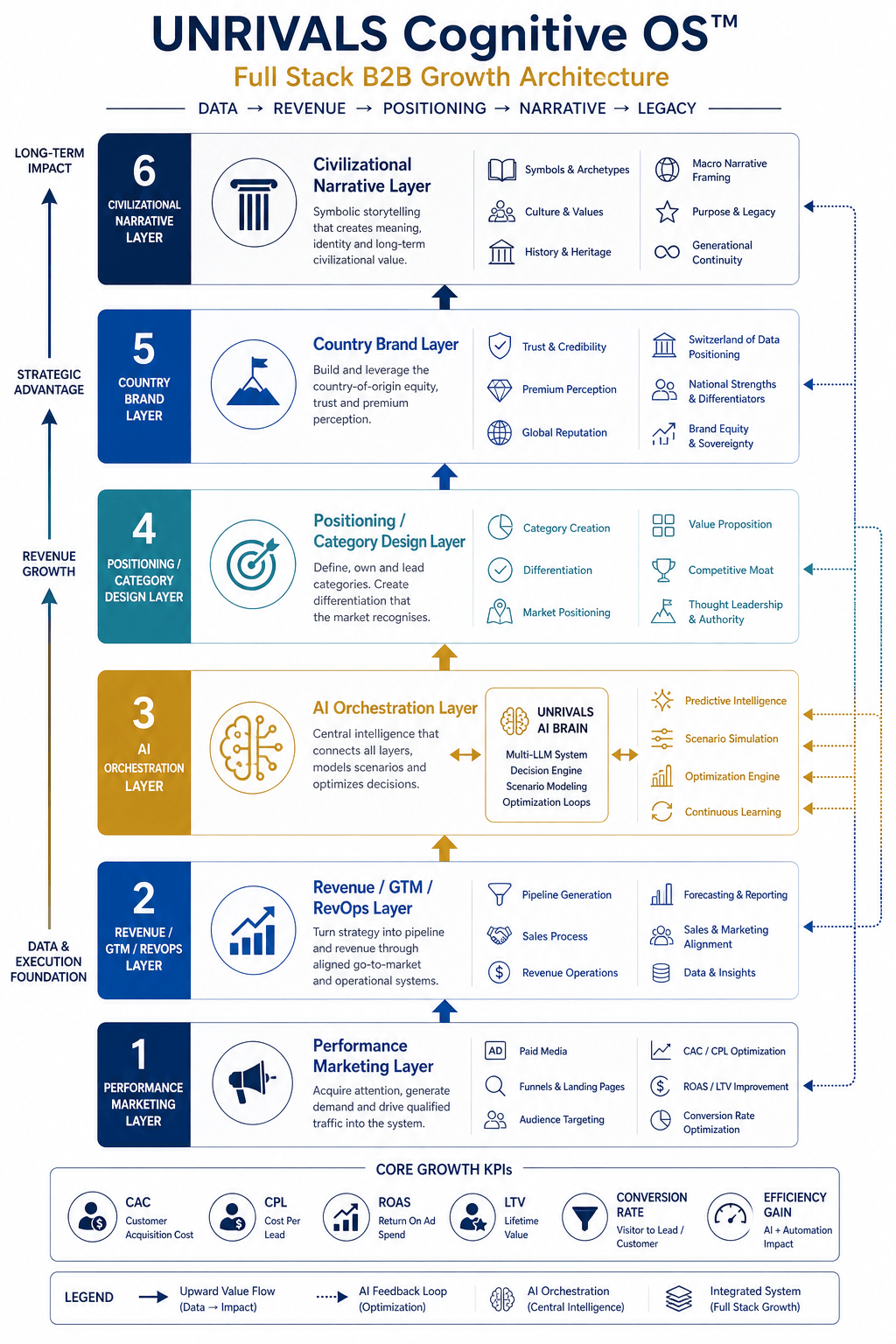
The UNRIVALS™ Framework
U = Understand Market
N = Niche Demand
R = Revenue Model
I = Intelligence
V = Value Proposition
A = Acquisition
L = Loyalty
S = Scale
The global B2B Strategy landscape is no longer playing by the old rules → Buyers are closing six-figure deals without ever speaking to a sales rep. AI is no longer a pilot project — it’s quietly reshaping every workflow, every touchpoint, every decision. And the brands that will win in 2026 aren’t necessarily the loudest ones, but the ones that show up clearly, earn trust fast, and remove every point of friction from the buyer’s path. The game has changed. Here’s how to play it → AI → define the B2B Strategy business category.
In 2026, B2B buyers close six-figure deals without ever speaking to a sales rep in many cases → AI agents actively participate in negotiations, while trust and clarity have become stronger differentiators than features or price alone. According to recent global research, procurement cycles now involve an average of 6–7 stakeholders, and risk aversion pushes decision timelines 20–40% longer in industrial and manufacturing sectors common in Romania and Eastern Europe. Companies that build integrated strategic systems — rather than isolated tactics — will capture the most value this year.
Supporting Clusters → B2B Strategy Execution Frameworks → AI-Driven Revenue Architecture and Symbolic Branding in Industrial B2B → Ultimate Guide to B2B Strategy in 2026 ↓ Original research → proprietary survey results from the Romanian/EE market.
In 2026, B2B markets are no longer shaped by product quality alone → Most categories already offer acceptable quality, similar pricing and comparable delivery capabilities. The new battlefield is different → clarity, trust, systems, positioning and commercial execution.
Many companies still react tactically → while markets move structurally. They launch campaigns without architecture, hire salespeople without process discipline, invest in tools without alignment and publish content without narrative control.
The result is predictable → noise without momentum → The companies that will outperform in 2026 are those that understand one principle: every market trend creates a business problem. Every business problem requires a strategic system ↓
The 7 defining B2B Strategy
Trends of 2026 → Romanian
B2B Business Environment ↓
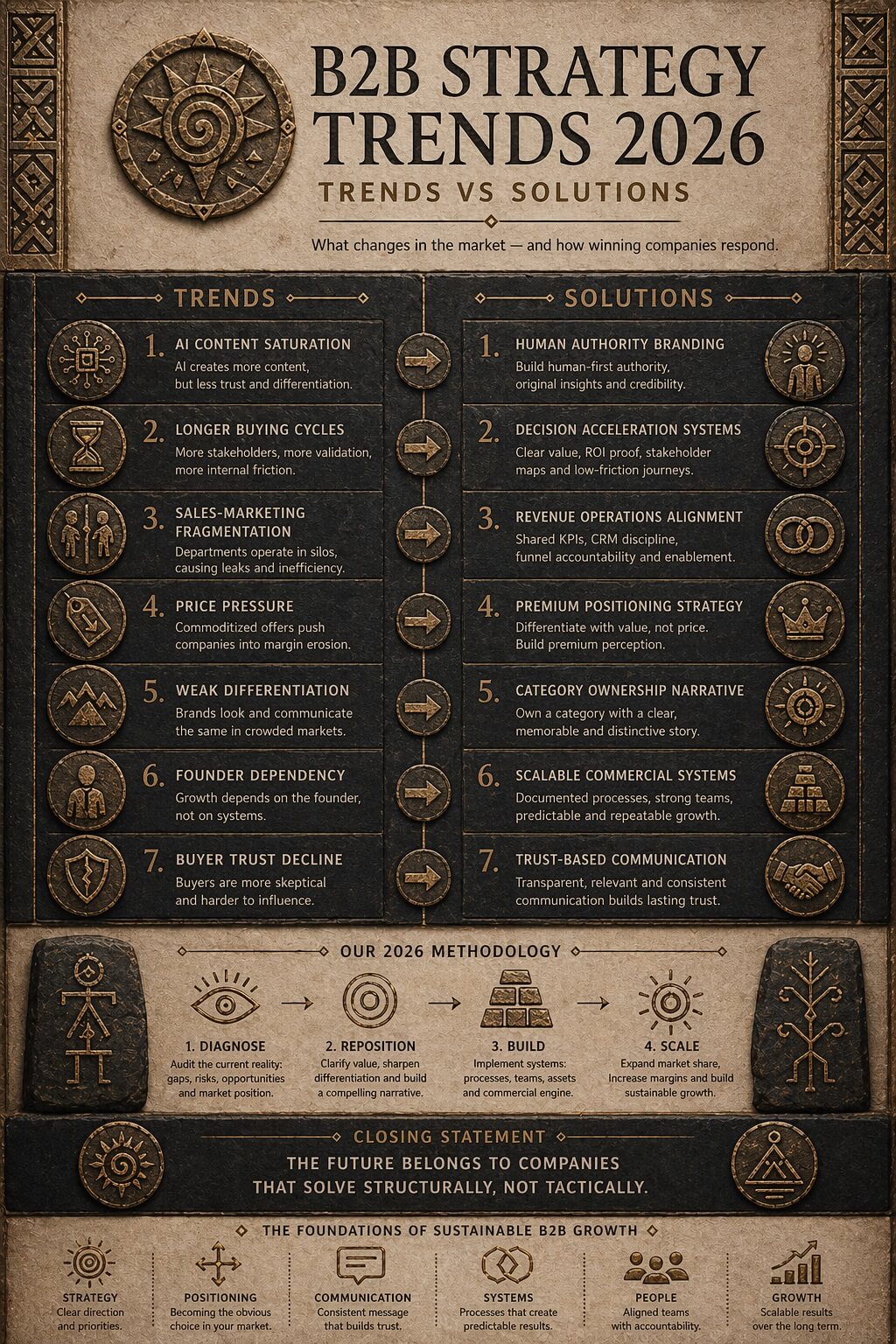
1. AI Creates More Noise, Not More Trust
AI tools can generate infinite content, proposals and campaigns. But buyers now face saturation. Solution: build human authority, original insight and trust-based communication systems. Companies that sound human will outperform companies that sound automated.
Recent proprietary insights from Romanian and EE client projects confirm that B2B buyers increasingly distrust generic AI-generated content. Over 60% of decision-makers report higher skepticism toward automated proposals, preferring human-led authority signals such as original research, founder insights, and transparent case studies. Building genuine human authority systems is no longer optional — it is the foundation for standing out in saturated markets.
2. Buyers Delay Decisions Longer ↓
This extension of buying cycles is particularly visible in Romania’s manufacturing, logistics, and technology sectors, where additional compliance and multi-level approvals are common. The practical solution lies in Decision Acceleration Systems that combine sharp ROI calculators, pre-packaged executive narratives, stakeholder-specific messaging maps, and seamless digital proof points to reduce perceived risk and move deals forward faster.
Procurement cycles involve more stakeholders, more caution and more internal validation. Solution: create decision acceleration systems → sharper value propositions → ROI proof → executive narratives → stakeholder messaging maps → lower-friction buying journeys.
3. Marketing and Sales Must Merge ↓
The historical split between lead generation and closing is becoming expensive. Solution → Revenue architecture → shared KPIs → CRM discipline → funnel accountability → sales enablement assets → common language across departments.
4. Commoditized Markets Punish Average Brands ↓ If your company looks similar to competitors, price becomes the main lever. Solution → Strategic Positioning: category ownership → premium identity → differentiated story → memorable market presence.
5. Content Must Become Strategic Assets ↓ Random posting no longer creates serious pipeline value. Solution → Build authority ecosystems: LinkedIn thought leadership → educational articles → commercial case studies → founder positioning → SEO trust libraries.
6. Heritage and Symbolism Become Differentiators ↓
Modern brands increasingly borrow timeless symbols, archetypes and deeper meaning systems. Solution: Narrative branding rooted in identity, memory and cultural intelligence. Brands with symbolic depth → create stronger recall than feature-based messaging.
7. Founders Must Scale Beyond Themselves ↓
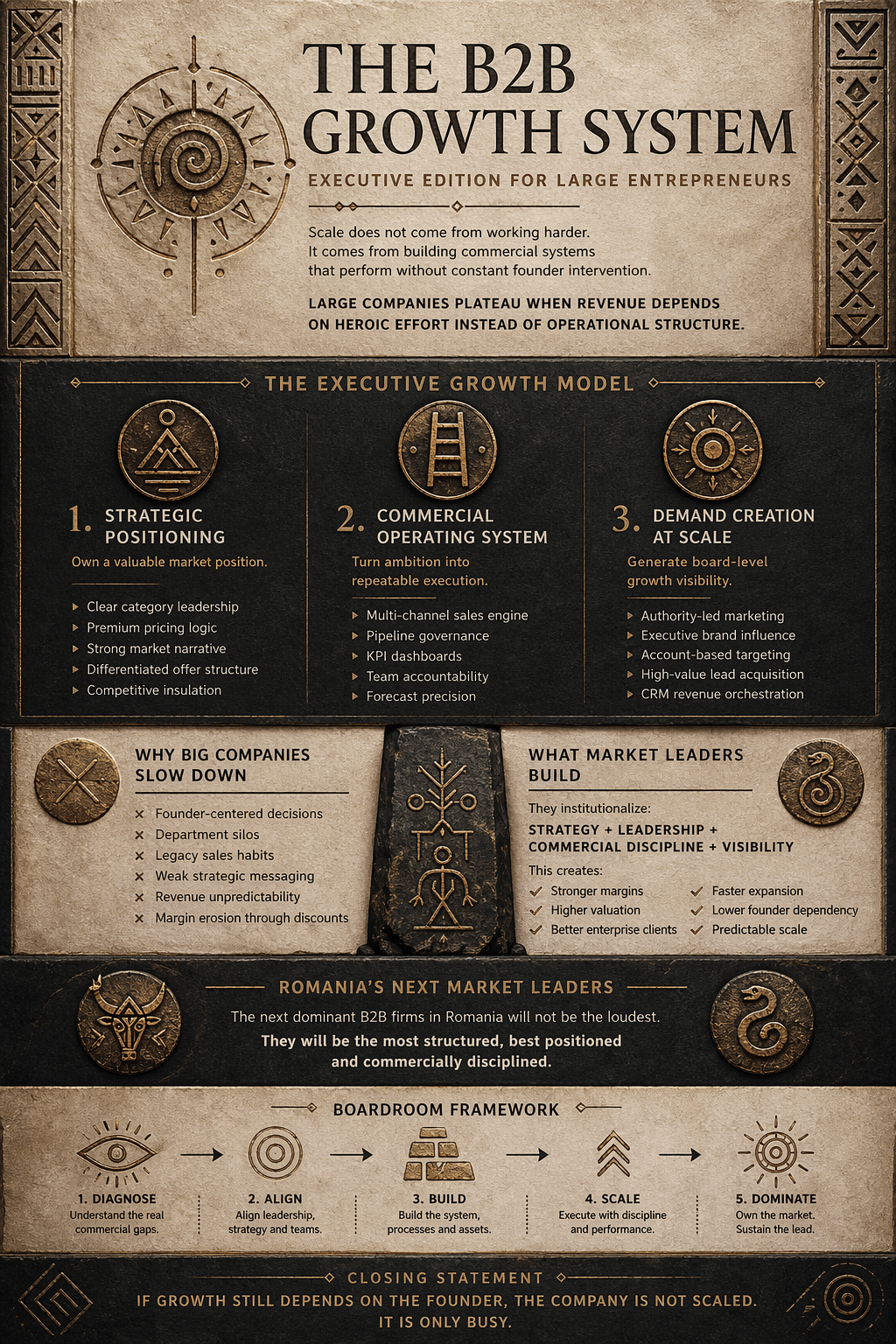
Many companies still depend on founder energy. Solution: Operationalize growth through systems → Audit -> Position -> Build -> Scale without founder dependency.
7 International B2B Strategy Trends
While local Romanian and Eastern European B2B environments face unique challenges such as founder dependency and regional commoditization, global forces shape the broader playing field. B2B e-commerce marketplaces alone reached $2.64 trillion globally in 2024 and continue expanding rapidly, with cloud-based platforms cutting procurement cycles by up to 67%. Romanian companies that align local execution with these international shifts gain a significant competitive edge.
1. Agentic AI — From Tool to Deal Participant 🤖 AI is no longer something you simply query — it has become an active participant in the deal. Around 20% of B2B sellers are now expected to respond to AI-powered buyer agents with dynamically delivered counteroffers via their own seller-side agents. Risingtrends The companies treating AI only as a content tool are already falling behind.
2. GEO — Generative Engine Optimization 🔍 How buyers find and recognize brands is being rewritten. More buyers are beginning their research journeys using AI agents, copilots, and chat-based tools instead of traditional search, making Generative Engine Optimization (GEO) — or AI discoverability — a critical new discipline for brand teams.
3. Trust as the #1 Conversion Driver 🛡️
As risk aversion rises, buyers prioritize brands that feel safe — transparent, reliable, and ethically aligned. In global B2B buying, feeling „safe to sign a contract” remains the number one decision driver, making trust the strongest predictor of who wins or loses the deal.
4. B2B Marketplaces & Vertical eCommerce Explosion 🏪 Global B2B marketplace sales hit $2.64 trillion in 2024, and cloud marketplaces are driving even faster adoption — already accounting for 14.4% of US B2B e-commerce and cutting procurement cycles by up to 67%.
5. Consumer-Grade Digital Experiences as the New Baseline 📱 With over 71% of B2B buyers being Millennials or Gen Z, and 75% of buyers willing to switch to a supplier offering a better online experience, the pressure is on for easy online ordering, transparent pricing, personalized offers, and seamless checkout that mirrors B2C standards.
6. Account-Based Marketing (ABM) Goes Operational 🎯 Effective ABM strategy in 2026 is tiered by design — one-to-one for strategic accounts, one-to-few for high-intent clusters, and one-to-many for scalable relevance. This shift is enabled by better intent data and a clearer understanding of how buying groups actually make decisions.
7. Supply Chain Transparency as a Competitive Edge 🌱 Visibility and automation are now core requirements for resilient supply chains. IoT-enabled sensors can detect more than 60% of potential supply chain disruptions earlier, helping organizations respond proactively rather than reactively — and supply chain visibility now directly impacts cost control, service reliability, and customer confidence.
The core 2026 principle is clear: your B2B brand must be discoverable by AI engines (through GEO optimization), trusted by humans, and experienced with consumer-grade simplicity. Success belongs to organizations that act with strategic clarity rather than tactical volume. In Romania, this means combining symbolic branding rooted in local heritage with modern revenue architecture and AI-augmented processes.
The B2B Strategy Takeaway 🎯 The message for B2B decision makers in 2026 is clear: your brand must be discoverable by machines, trusted by humans, and experienced as effortlessly as possible. 2026 isn’t about doing more — it’s about doing the right things with greater clarity. B2B International The winners will be those who act on these shifts now, not those who watch them happen.
What are the top B2B strategy trends for 2026 in Romania? Key local trends include rising AI noise versus human trust, longer buyer decision cycles, the need for marketing-sales integration (revenue architecture), category ownership to fight commoditization, and founder-independent scaling systems. Why does GEO matter for B2B companies in 2026? More buyers begin research in AI tools like ChatGPT, Perplexity, and Gemini instead of traditional Google search. Generative Engine Optimization helps your content appear naturally in AI-generated answers, driving visibility in the new discovery landscape. How can Romanian B2B firms compete globally? By owning a clear category position, developing symbolic narrative branding, implementing integrated revenue systems, and delivering frictionless digital experiences that match international standards.
Companies that treat these trends as isolated tactics risk falling behind 🎯 Those that translate them into cohesive strategic systems — combining positioning, trust-building, and execution frameworks like UNRIVALS — position themselves for sustainable growth in 2026 and beyond. Start by auditing your current buyer journey and content ecosystem for alignment with these shifts.
B2B STRATEGY BOS
UNRIVALS Study Case 🔍 Leveraging Romania’s Country Brand Equity for B2B Category Ownership → Romania’s country brand equity is mid-tier globally, with measurable strengths in trade, talent, and emerging soft power, yet facing challenges in worldwide awareness and prestige. This directly influences how Romanian B2B companies position themselves, win international deals, and escape commoditization. Recent benchmarks confirm the nuance: Brand Finance Global Soft Power Index 2026 ranks Romania 53rd (up 2 places), with notable gains in technology perception, trustworthiness, and cuisine. Bloom Consulting’s Trade Ranking places the country 38th worldwide, highlighting solid business and investment appeal. While tailwinds such as strategic EU/NATO location, competitive costs, and skilled IT/engineering talent support FDI and exports, headwinds like lingering stereotypes require deliberate effort to reduce price scrutiny and build premium perception. The most powerful differentiator lies in our ancient heritage. Few nations can claim a living symbol like Cuina Turcului — a site continuously inhabited for approximately 13,000 years, with Epipaleolithic roots predating Mesopotamian civilizations by 8,000 years. This deep European continuity embodies resilience, innovation, and longevity unmatched by Western competitors.
Proof of B2B Strategy Methodology 📱 A „Blue Ocean” Case Study Applying the UNRIVALS framework, Romanian B2B leaders can transform this heritage into a true category ownership strategy. By combining proven cost and talent advantages with authentic “GENESYS” storytelling, companies create hybrid positioning that moves beyond “value-for-money EU supplier” into trusted, long-term strategic partners. This approach mitigates country-of-origin bias through EU certifications, strong case studies, and digital proof points while building symbolic depth that resonates in IT, manufacturing, automotive, renewables, and sustainable solutions.
The result is a competitive moat → Romania’s brand equity becomes a net positive enabler for higher-value positioning rather than a limiter. The 13,000-year continuity at Cuina Turcului is no longer just history — it becomes the foundation of a modern “Genesys” brand umbrella for Romanian entrepreneurship and B2B excellence. This study case demonstrates how UNRIVALS turns national brand equity into actionable B2B advantage → Switzerland of DATA audit current perceptions, own the heritage narrative, build symbolic authority, and execute with integrated revenue systems inside the modern AGI worldwide approach to discover AI patterns hidden in 7,000 years of history that no one is connecting.
Daniel ROȘCA COGNITIVE OS™
📞 0758273142 📩 Let’s TALK ↓
Sources → © B2B Strategy ™ original research Romanian Data Bases of agency clients → FedEx Newsroom — B2B Business Trends Defining 2026 → B2B International — 9 Trends Shaping B2B Brands in 2026 → Commercetools — 4 AI Trends Shaping B2B Digital Commerce → Rising Trends — B2B Ecommerce Trends 2026 → Only-B2B — 8 B2B Marketing Trends for 2026 ↓
Etichete: B2B Strategy™, Blue Ocean Strategy, Brand Equity Strategy, Branding, Business Strategy, Daniel ROŞCA, Nation Branding, reBranding, Strategic Vision, U N R I V A L S, UNRIVALS